Artificial Intelligence Assistant – Live Demo
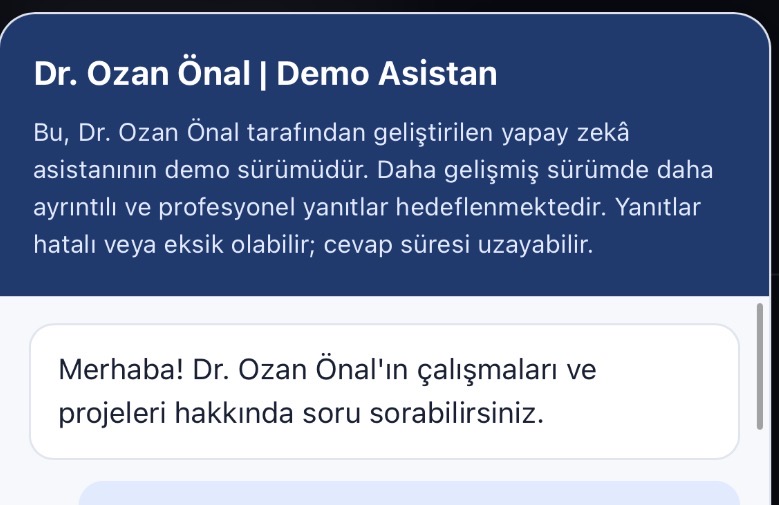
ATTENTION: THIS APPLICATION IS A DEMONSTRATION VERSION ONLY. The purpose of this version is not to deliver highly accurate responses, but to demonstrate the integration and operational feasibility of the developed artificial intelligence architecture in a live environment. Due to limited server resources, the demo uses a lightweight language model. Therefore, accurate, consistent, or meaningful responses to every question should not be expected. The system may generate incomplete, incorrect, or irrelevant answers. Dr. Ozan ÖNAL has also conducted development work using higher-capacity language models to build systems with more advanced contextual understanding and response generation capabilities. The current demo does not represent the final performance of these development efforts. About the Project: This artificial intelligence assistant, developed by Dr. Ozan ÖNAL, integrates natural language processing, document-based information retrieval, semantic search, and RAG architecture. The system supports local deployment and, when appropriately configured, can process information without transmitting data to external AI services. The live demo primarily focuses on the developer's academic research, projects, and professional expertise.
Project Overview
This project was developed by Dr. Ozan ÖNAL to explore the practical integration of artificial intelligence, natural language processing, and information retrieval technologies.
The study combines open-source language models, semantic search methods, and vector database technologies to implement a document-based artificial intelligence assistant.
The primary objective is to demonstrate how language models can be integrated with specialized knowledge sources to retrieve relevant information and generate natural language responses.
The current implementation enables questions about Dr. Ozan ÖNAL's academic research, projects, and areas of expertise.
Methodology and Technologies
The system uses Retrieval-Augmented Generation (RAG) architecture.
Documents are processed and divided into text segments. Embedding models convert these segments into vector representations, which are stored in a vector database.
When a user submits a question, semantically relevant information is retrieved and provided to the language model as contextual input for response generation.
The main technologies used in the project include:
Python
Open-source language models
Retrieval-Augmented Generation (RAG)
Sentence Transformers
ChromaDB
Streamlit
Linux
The implementation covers document processing, knowledge base construction, semantic retrieval, user interface development, and language model integration.
A software structure supporting separate workspaces and knowledge sources has also been developed.
Local Execution and Data Privacy
An important technical aspect of the project is the ability to execute the language model and information retrieval components in a local environment.
The language model, embedding model, and vector database can operate on a local computer or dedicated server.
This enables document processing, information retrieval, and response generation without relying on external AI inference services.
In fully local deployments with appropriately restricted external connections, data can be processed without being transmitted to external AI services.
This approach is relevant to data privacy, information security, and reducing dependence on external services.
However, secure operation also requires appropriate access controls and other security measures.
Live Demo and Limitations
A live demonstration has been deployed to illustrate the fundamental functions of the developed system.
The demo operates on a server with limited hardware resources. Consequently, a lightweight open-source language model is used.
Larger language models may require additional RAM, GPU memory, and computational capacity, depending on their characteristics and deployment configuration.
Due to the limited capacity of the model used in the current demo, some questions may be misinterpreted, and responses may be incomplete or inaccurate.
For example, when asked an ambiguous question such as "Where are you from?", the system may incorrectly interpret the intended context and generate a response based on information about Dr. Ozan ÖNAL.
This behavior illustrates how language model capacity and information retrieval mechanisms can affect response quality.
The current knowledge base is limited to selected academic and professional subjects. Therefore, the system is not intended to answer general knowledge questions.
The live demo is intended to demonstrate the technical feasibility of the developed architecture rather than its final accuracy or performance.
Experiments with Different Language Models
During development, experiments were conducted with open-source language models of different parameter sizes.
These activities examined hardware requirements, local execution, and integration with document-based question-answering systems.
Higher-capacity language models may provide advantages in contextual understanding and response consistency for certain tasks.
However, overall system performance also depends on knowledge base coverage, semantic retrieval quality, relevance of retrieved information, and response generation methods.
Evaluation of the Study
This project demonstrates the implementation and live deployment of a document-based artificial intelligence assistant using open-source technologies.
It provides a practical example of integrating language models with specialized knowledge sources and examining their feasibility in local and resource-constrained computing environments.
The project design, software development, model integration, information retrieval infrastructure, and live deployment were carried out by Dr. Ozan ÖNAL.